Booed Off at Silverstone: Can F1 Fix Its Safety Car Finish Without Selling Its Soul?
The biggest crowd in F1 history watched a thrilling British Grand Prix end in formation behind a Mercedes road car. The rules were followed to the letter — and that’s precisely the problem.
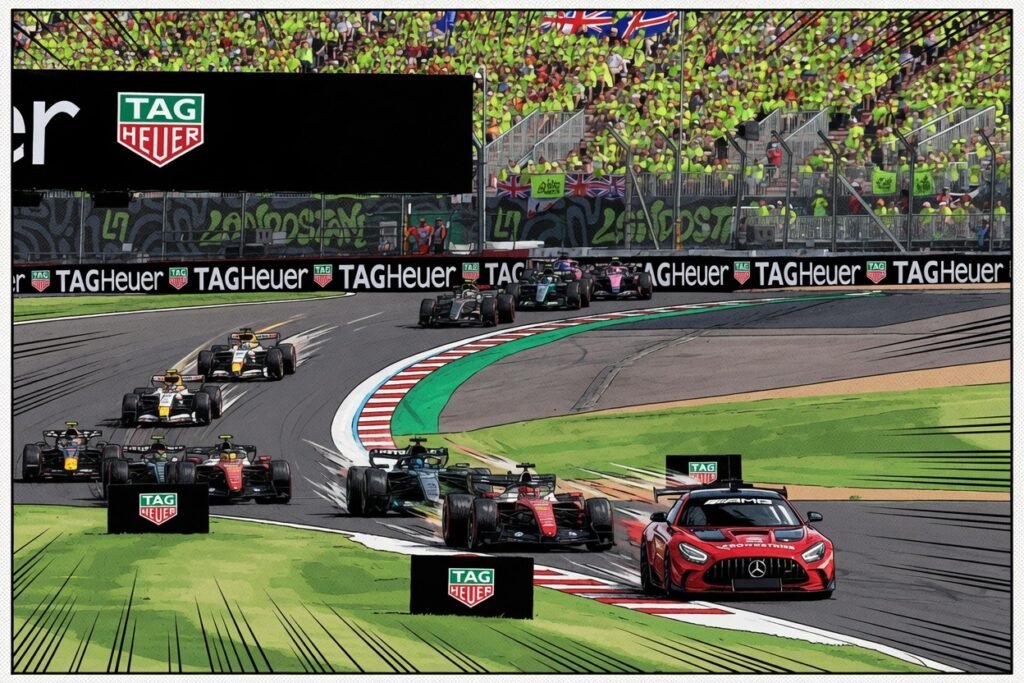
The sound Silverstone made in the closing moments of the British Grand Prix was not the one 564,000 people had come to hear. As the safety car swept past Club for the final time, the anticipated eruption of cheers became a wave of boos, and the grandstands emptied before the cooldown lap had even begun. Max Verstappen’s crash at Stowe with six laps left had triggered a safety car; the unlapping procedure consumed the time remaining; and Charles Leclerc’s hard-earned win was sealed in formation rather than in combat. Nobody broke a rule. That, more than anything else, is why the argument has refused to die all week.
What actually happened — and what didn’t
Two separate things went wrong at Silverstone, and conflating them has muddied the debate. The first was a genuine error: race control’s “Safety Car In This Lap” message flashed up on the penultimate tour, promising a one-lap shootout, before being overruled eight seconds later. The FIA has attributed that to a software glitch, caught and corrected in real time — an embarrassment, but not a procedural failure.
The second was not an error at all. Under post-Abu Dhabi 2021 regulations, once lapped cars are waved past the safety car, a full lap must be completed before racing can resume. With just over five laps remaining when the safety car deployed, the arithmetic simply didn’t work. The procedure was followed exactly as written — which is precisely the point, and precisely the contrast with 2021, when it wasn’t. The question, then, isn’t why F1 broke its own rules at Silverstone. It’s why those rules produce this ending at all.
The core problem, in one paragraph
- Lapped cars must be waved past the safety car, then a full lap must be completed before green flags.
- On long circuits like Silverstone and Spa, that procedure alone can eat every remaining lap.
- The rule exists to stop backmarkers distorting the finish — a legitimate sporting protection.
- But it prioritises drivers out of contention over the leaders and, ultimately, the fans in the stands.
The fixes on the table
Send the backmarkers down the pitlane
The idea gathering most momentum, championed by Martin Brundle, is borrowed directly from IndyCar: within the closing laps, lapped cars peel into the pitlane and rejoin at the back of the field, rather than being waved around on track. The order is corrected, the leaders are protected from backmarker interference, and — crucially — no extra lap is burned. By the time a late safety car arrives, the leaders have long since pitted, so the pitlane sits largely empty. Brundle’s blunt framing of the status quo cuts to the heart of it: F1 currently prioritises “runners who haven’t been good enough, for whatever reason, on the day, instead of the leaders and most importantly the fans.”
Simply drop them to the back
A simpler variant skips the pitlane entirely: lapped drivers lift off and slide in behind the pack. No detour, no procedural lap, no technical breakthrough required — just a rule change. The trade-off is that those cars lose the chance to unlap themselves and rejoin the fight, which some argue is a small price for restoring green-flag racing.
Throw the red flag
The most interventionist option, and the most divisive: red-flag any race requiring a safety car inside the final laps, then restart. IndyCar does exactly this within its last ten laps. It guarantees a racing finish — but at a genuine cost, injecting a randomising element into a race a driver may have controlled on pure pace. Leclerc led Silverstone from lights to flag; a red flag would have handed his rivals a free shot at him through no fault of his own. That’s a legitimate trade-off, not a clear improvement.
Why nothing has changed before
This debate isn’t new, and its history is instructive. After Abu Dhabi 2021, the FIA and Formula 1 pushed hard for a rule change to eliminate safety car finishes. The teams — every single one of them — voted to keep the regulations exactly as they were, unable to agree on any alternative that didn’t create fresh sporting distortions of its own. Every proposed fix carries unintended consequences, and in a sport where a tenth of a second decides championships, teams are structurally allergic to rules that could randomly cost them positions.
That inertia is exactly what Silverstone has now put back under pressure. The counterargument — that F1 is a sport first and entertainment second, that it doesn’t owe anyone a Hollywood ending — remains genuinely principled, and the frequency of safety car finishes is low enough that some argue this simply isn’t worth solving. But there’s a meaningful distinction between manufacturing drama and removing artificial obstacles to it. Sending lapped cars through the pitlane doesn’t fabricate a finish; it stops a procedural detail from stealing one.
- Silverstone drew F1’s largest-ever race weekend attendance — 564,000 across four days.
- Every team voted to retain the existing safety car rules after Abu Dhabi 2021, citing sporting fairness.
- NASCAR, IndyCar and Formula E all use mechanisms to guarantee green-flag finishes.
- Any change would require agreement between the FIA, Formula 1 and the teams — historically the hardest part.
F1 doesn’t need to choose between sporting integrity and a proper finish. What Silverstone exposed isn’t a safety car problem or an entertainment problem — it’s a rules problem, and rules can be rewritten. The teams rejected change once because no option seemed clean enough. Booed off at their own showpiece event, in front of the biggest crowd the sport has ever assembled, they may find that calculation harder to defend the second time around.
Discover more from f1liveupdates.com
Subscribe to get the latest posts sent to your email.