Formula 1 · Technical Analysis
Why Red Bull Has Parked Its ‘Macarena’ Wing for the Belgian Grand Prix
The RB22’s clever rotating rear wing promised less drag and more speed. After two high-speed Verstappen incidents, Red Bull has chosen certainty over innovation at Spa.
Red Bull’s decision for Spa-Francorchamps is as logical as it is significant. The team has parked its rotating “Macarena” rear wing and returned to the conventional design used at the start of 2026, following two separate failures that sent Max Verstappen off the road in consecutive race weekends.
This is not Red Bull abandoning the concept. It is Red Bull acknowledging that Spa is not the place to test the limits of a wing mechanism that has already caused two high-speed incidents. At a circuit defined by Eau Rouge, Raidillon and long flat-out sections, reliability is not merely a performance concern. It is a safety requirement.
The decision reveals the difficult trade-off behind Formula 1 innovation. The wing was designed to reduce drag. At Spa, that benefit would be particularly valuable. But a gain that cannot be trusted is no gain at all.
“We’ll go back on the old one.” Max Verstappen on Red Bull’s Belgian Grand Prix rear-wing choice
What is the ‘Macarena’ wing?
The nickname describes a new generation of rotating rear-wing concepts introduced under Formula 1’s 2026 active-aerodynamics regulations. Rather than relying only on a conventional flap movement, the main element rotates in straight-line mode to open the wing dramatically and reduce aerodynamic drag.
Ferrari first brought a version of the idea to winter testing. Red Bull followed with its own distinct solution, which arrived in Miami after further development work. While the shared nickname suggests identical designs, the mechanisms are different. Each team has pursued its own way of managing the flap’s movement and its return to the high-downforce configuration.
In theory, the upside is clear: less drag on the straights means a higher terminal speed, more efficient energy use and a stronger chance to defend or attack. In practice, the rear wing is also a critical source of high-speed stability. If it does not return correctly, the driver can lose downforce at precisely the point they need the car to be most predictable.
Why the name matters less than the mechanism
“Macarena” has become shorthand for the rotating rear-wing idea. The decisive issue is not the nickname, but whether the mechanism can reliably close and restore the aerodynamic load that gives the driver confidence at high speed.
Two incidents, two warnings
The first major warning came in Austrian Grand Prix qualifying, when Verstappen suffered a heavy crash after his rear wing failed to close properly. Red Bull investigated that incident and believed it understood the specific cause.
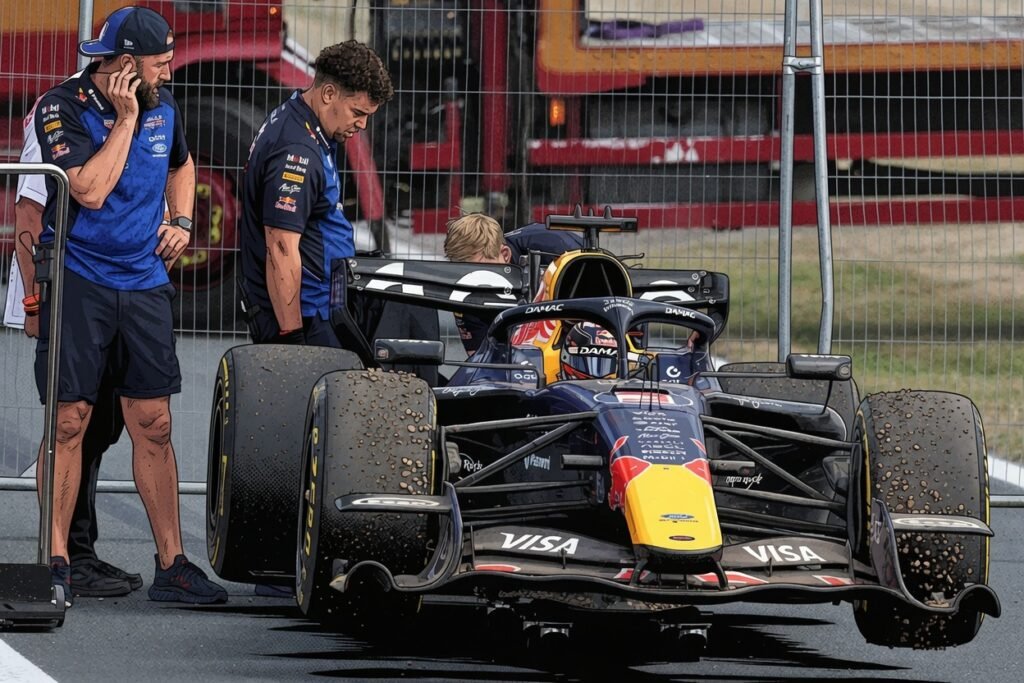
A week later at Silverstone, the problem returned with a different fault and the same consequence. Verstappen was running third, with a possible podium in sight, when he spun into the gravel at Stowe late in the British Grand Prix.
Verstappen’s explanation captured the danger simply: when the rear wing does not close fully, a car loses downforce. At high speed, that change is not a small balance adjustment. It can remove the rear-end security a driver expects from one corner to the next.
- Austria: Verstappen crashed in qualifying after a rear-wing closing problem.
- Silverstone: A different rear-wing fault ended his race while he was fighting for a podium.
- Spa: Red Bull has reverted to its earlier conventional wing while modifications are developed.
- FIA attention: The governing body is taking a closer look at the rotating-wing designs.
Why Spa changes the calculation
Spa-Francorchamps is a circuit where drag reduction can make a large difference. Its long straights and fast transitions reward aerodynamic efficiency, while the new-generation cars’ energy-management demands make every reduction in resistance valuable.
Yet Spa is also the worst possible venue for uncertainty in a rear-wing system. The speeds are high, the corners are long and committed, and a sudden loss of downforce can quickly become a major incident. Red Bull cannot take a third chance with a component Verstappen has described as dangerous.
The conventional wing may cost the RB22 some straight-line efficiency. But it gives the team a known aerodynamic platform and gives Verstappen a car he can push without wondering whether the rear of the car will behave as expected when the wing transitions back to its cornering configuration.
At Spa, reliable downforce is worth more than theoretical drag reduction. Red Bull’s technical compromise for Belgium
Ferrari’s contrast and Red Bull’s response
Ferrari’s rotating-wing approach has not experienced the same public reliability problems. That does not make the concepts directly comparable, but it underlines the challenge for Red Bull: a promising aerodynamic idea still has to survive the loads, heat, vibration and rapid state changes of a Grand Prix weekend.
Red Bull remains committed to the potential of its design. The team is working on modifications and intends to bring the rotating wing back once it is satisfied that the risk has been removed. This is a pause, not a permanent technical retreat.
But Formula 1 is unforgiving of development that arrives before it is ready. McLaren, which has also explored a rotating rear-wing concept, chose not to run its version when it judged the design insufficiently mature. Red Bull now finds itself taking the same cautious route, only after the cost of two incidents.
What to watch in Belgium
The immediate question is how much Red Bull sacrifices in straight-line efficiency with its conventional wing. The more important question is whether the revised rotating design returns later in 2026 as a fully reliable performance weapon—or remains a reminder of innovation pushed too hard.
The verdict
Red Bull’s Spa decision is not conservative; it is necessary. The team has chosen the safer, understood solution because the alternative has produced two serious warnings in two weeks.
The “Macarena” wing may yet become a powerful part of the RB22 package. For now, though, the priority is uncomplicated: restore Verstappen’s confidence, ensure a stable rear platform and prove that the pursuit of less drag never comes at the expense of control.
Sources
- Autosport — Red Bull parks ‘Macarena’ rear wing for Belgian GP after Verstappen crashes
- Motorsport.com — Red Bull investigates Verstappen’s rear-wing failure
- Formula1.com — Verstappen details the rear-wing issue behind his Silverstone crash
- Verstappen.com — Laurent Mekies confirms rear-wing issue and Red Bull response
Discover more from f1liveupdates.com
Subscribe to get the latest posts sent to your email.