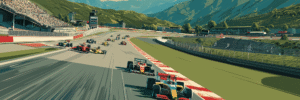

Madrid returns to Formula 1, and the championship arrives with it
The Spanish Grand Prix moves to a brand-new hybrid circuit on the edge of the capital this weekend. The Madring is untested, the weather is hot, and the title fight has a clear leader who still has work to do.
Formula 1 has not raced in Madrid since Gilles Villeneuve won at Jarama in 1981. Forty-five years later, the championship returns to the Spanish capital with a different brief and a different circuit. Round 14 of the 2026 season, officially the Formula 1 Tag Heuer Gran Premio de España, will be held from Friday 11 to Sunday 13 September at the Madring, a 5.414-kilometre hybrid layout stitched around IFEMA Madrid and Valdebebas.
The event is not a revival of the old Jarama race. It is a first Grand Prix on a new track, with no lap record, no historical tyre map and no established overtaking script. That is the point of the weekend. Every team will start from the same blank page.
From an energy perspective, the Madrid circuit ranks among the five most demanding on the calendar, with lateral forces comparable in intensity to those recorded at Barcelona and Silverstone.
Pirelli weekend preview, via Formula1.com
A second Spanish race, with a new identity
Spain already hosted a Grand Prix this season. The Circuit de Barcelona-Catalunya ran in mid-June under its own event title. Madrid now takes the Spanish Grand Prix name, the sixth different venue to do so in the Formula 1 era, and becomes the last European stop before the calendar turns east to Baku.
The FIA and Formula 1 placed the race here when the 2026 calendar was approved in June 2025. Imola dropped off the schedule. Madrid arrived as the new venue of the season, part of a compacted European run that begins in Monaco and ends in the capital. The championship then leaves the continent.
There is no Sprint this weekend. The format is the classic one: two practice sessions on Friday, a final hour and qualifying on Saturday, the Grand Prix on Sunday afternoon.
Weekend timetable — local time, Madrid
| Session | When |
|---|---|
| Free Practice 1 | Friday 11 September, 13:30 CEST |
| Free Practice 2 | Friday 11 September, 17:00 CEST |
| Free Practice 3 | Saturday 12 September, 12:30 CEST |
| Qualifying | Saturday 12 September, 16:00 CEST |
| Spanish Grand Prix | Sunday 13 September, 15:00 CEST |
Formula 2 and Formula 3 support the meeting throughout the weekend.
What the Madring actually is
The circuit is neither a pure street track nor a conventional permanent venue. Public-road stretches sit beside purpose-built high-speed sections. Official figures list 22 corners and a first-lap run of only about 200 metres from the pole position line to the Turn 1 braking point. Cars are expected to approach 340 km/h on the fastest stretch. The race is scheduled for 57 laps.
Williams driver Carlos Sainz, born in Madrid and appointed circuit ambassador, has described the layout as a blend of Baku and Jeddah: long, committed, and technically restless. The first sector is fast. The middle of the lap tightens into medium- and low-speed corners, some of them 90-degree changes of direction of the kind drivers already know from Azerbaijan. Then the track changes character again.
La Monumental
The signature is Turn 12, named La Monumental after the curve of a bullring. Formula 1’s official circuit guide puts the banked section at 550 metres, with a gradient of up to 24 percent, and room for around 45,000 spectators above it. Cars are projected to spend roughly six seconds in the banking at more than 300 km/h. Pirelli says the corner will generate the highest vertical load of the entire season, not only because it is banked but because it is long.
Multiple racing lines are built into the design. The reward sits immediately afterwards: a heavy braking zone into a slow corner where the speed drops from the high 300s towards 140 km/h. That is the first place the circuit is supposed to produce a pass. Getting the Monumental wrong will not only cost a tenth. It will hand the following corner to the car behind.
There is also a tunnel on the return towards IFEMA and a technical final sector that will decide qualifying. Track limits, dirty asphalt and confidence will matter as much as peak downforce.
Circuit notes for Sunday
- Length: 5.414 km, 22 corners, first Formula 1 Grand Prix.
- Race distance: 57 laps.
- Start to Turn 1: approximately 200 metres.
- Projected top speed: around 340 km/h.
- La Monumental: about 550 m, banking up to 24%, highest vertical load of 2026 according to Pirelli.
- Asphalt is new and very smooth, with relatively low grip after high-pressure water treatment to clear dust and oily residue.
Tyres, heat and an unknown surface
Pirelli brings the C2 hard, C3 medium and C4 soft compounds. That is a conventional mid-range allocation, but the surface underneath it is not conventional. The asphalt is newly laid and unusually smooth. Grip is expected to start low and climb as rubber goes down, which is why Friday will be more than a systems check. It will be the first serious reading of how quickly the track comes to the cars.
An earlier Formula 3 test on the same circuit produced 19 red flags. That does not automatically forecast chaos for Formula 1, but it does confirm the obvious: a new hybrid venue with limited runoff in places will punish small mistakes. Safety-car probability is, for now, an empty column in every preview.
The weather will not offer a cooling-off period. Friday in Madrid is forecast to be sunny and close to 31°C. Saturday looks similar. Sunday is expected to be hotter still. Tyre degradation, brake temperatures and cooling capacity sit beside the usual questions of ride height and energy deployment. Under the 2026 regulations the cars already run on advanced sustainable fuels. Madrid, Pirelli says, will ask more of that energy system than most tracks on the list.
The championship arrives with a favourite
Kimi Antonelli leads the drivers’ championship on 267 points after 13 rounds. The Mercedes driver arrives from Monza, where he won from 19th on the grid, and holds a 66-point advantage over teammate George Russell on 201. Lewis Hamilton is third for Ferrari on 191. Lando Norris sits fourth after winning in Hungary and the Netherlands. Charles Leclerc is fifth, Max Verstappen sixth.
Mercedes leads the constructors’ championship on 468 points, 122 clear of Ferrari, with McLaren third. Ten Grands Prix remain after Madrid if the current calendar holds, which is enough for the standings to move and not enough for anyone to treat the weekend as an exhibition.
Monza left debris behind the numbers. Hamilton and Leclerc made contact on the opening lap. Leclerc crashed. Hamilton later said Ferrari needed to change the way it handled intra-team battles. Madrid is the first chance to see whether that conversation produced anything quieter.
This won’t be the first time that Madrid has welcomed F1, as the Circuito del Jarama, north of the capital, held nine rounds of the World Championship between 1968 and 1981.
Formula1.com, Need to Know preview
Home voices in a new paddock
Two Spanish drivers start this race with different kinds of pressure. Sainz, now at Williams, finally has a home Grand Prix in the city rather than a national one two hours up the Mediterranean coast. Fernando Alonso, still with Aston Martin, knows every register of a Spanish crowd and will not need reminding that points have been scarce. Neither Williams nor Aston Martin has been a regular visitor to the top ten this season. A new circuit is one of the few remaining places where that can change in a single afternoon.
The rest of the grid is the 2026 field as it now stands: eleven teams, twenty-two cars, new power-unit rules, and names that were not on the list two years ago. Cadillac has yet to score. Audi is still collecting its first fragments. Red Bull has spent the year chasing a problem Max Verstappen has already described as unresolved. None of that is unique to Madrid. All of it will be measured against a track nobody has raced.
What Friday has to answer
The useful questions are practical. How much grip appears between the first green light and the end of FP2. Whether La Monumental is a passing tool or a tyre tax. How short the run to Turn 1 really feels when twenty-two cars arrive together. Whether the low-grip surface pushes everyone towards a one-stop that looks tidy in simulation and comes apart in dirty air.
Qualifying on Saturday at 16:00 local time will be the first public ranking of the Madring. The Grand Prix follows at 15:00 on Sunday. After that the European season is over, and the field goes to Azerbaijan with a set of data that did not exist on Thursday night.
Madrid has waited since 1981 for this. The sport has built a circuit that is supposed to look like nothing else on the calendar. The only verdict that counts will be written in 57 laps, in heat, on asphalt that has never held a Formula 1 race.
Sources
- → Motorsport.com — F1 Spanish GP at Madring: Friday schedule, weather forecast and how to watch
- → Motorsport.com — Madring circuit characteristics, corners and race distance
- → Formula1.com — Need to Know: facts, stats and trivia ahead of the 2026 Spanish Grand Prix
- → Formula1.com — Circuit guide: everything you need to know about the Madring
- → Formula1.com — 2026 race calendar and Spanish Grand Prix listing
- → FIA — Official 2026 Formula One World Championship calendar announcement
Discover more from f1liveupdates.com
Subscribe to get the latest posts sent to your email.