Austin tyre strategy: one stop or two for Antonelli and the chasing pack?
Two hard, three medium and eight soft sets per driver, a likely one-stop according to Pirelli, and five cars within 0.276s on the grid: the strategy options for the 56-lap United States Grand Prix.
The 56-lap United States Grand Prix is a tyre race before it is anything else. Pirelli has brought its hardest C2 as the hard, the C3 as the medium and the C4 as the soft, with two sets of hard, three of medium and eight of soft for every driver, plus an extra soft for those who reached Q3. The tyre maker’s own preview points to a likely one-stop race; the heat could open the door to something else.
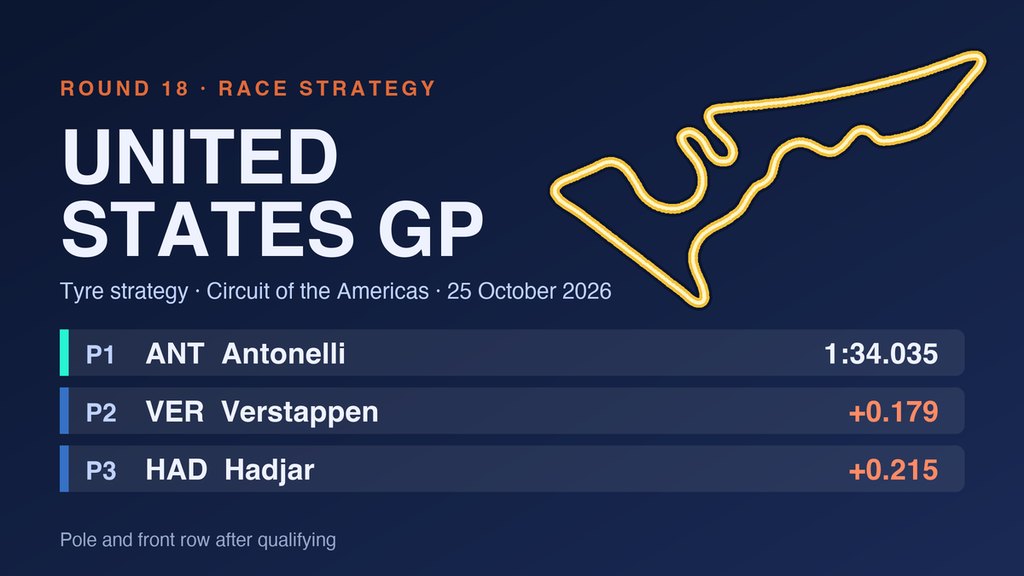
Kimi Antonelli starts on pole, 0.179s ahead of Max Verstappen, with Isack Hadjar third. Five cars are within 0.276s on the grid, so a stop made a lap too early or too late is enough to change the order. The start is at 15:00 in Austin, 21:00 in Paris.
What Pirelli expects at the Circuit of the Americas
Pirelli says the track loads both axles: the fronts suffer most in the first sector, while the many acceleration zones out of slow corners heat the rear tyres in the third. The asphalt is not especially abrasive, but it is ageing and wear is high over most of the lap. Turns 9 to 11 were resurfaced this year, and track grip is good with little evolution. Pirelli expects wear rather than graining to decide stints, and says the hard could favour long stints and a one-stop. At least two different dry compounds must be used in the race.
What practice tells us
Nobody ran a race-length stint on Friday or Saturday morning: the longest clean runs were 9 to 11 laps. We measured how lap time moved with tyre age on the clean stints of at least seven laps in FP1, FP2 and FP3 (in-laps, out-laps and slow laps removed).
These are median slopes over short runs, not fuel-corrected, and fuel burn hides part of the wear: they show that no compound fell off a cliff in ten laps, not how it will behave after thirty. The order between soft and hard is within the noise.
The strategies on the table
These are scenarios built from the allocation and the length of the race, not predictions. We have not measured the pit-lane time loss in Austin this weekend, and it is the number that decides between one stop and two.
- One stop, soft to hard. Start on the soft, stop around a third of the way through, and run about 35 laps on the hard. It uses one of the two hard sets and is the plan Pirelli’s preview points to.
- One stop, medium to hard or soft to medium. A safer stint length at the cost of some opening pace; the medium has only three sets, so it is a choice, not a default.
- Two stops, soft–soft–medium or soft–medium–hard. Three shorter stints on fresher rubber. It pays if the pit loss is small or if heat pushes wear beyond what practice suggested.
What the grid means for drivers
The leaders all set their Q3 times on softs, but nobody has to start on the tyres used in qualifying: the starting compound has been a free choice since 2022, so the real decision is which compound goes on at the first stop. The two Ferraris (Charles Leclerc fourth, Lewis Hamilton fifth) and the two Red Bulls are close enough that an undercut can decide who leaves the pits ahead. Further back, an alternative strategy is the best chance of climbing the order. Lando Norris starts eighth after a Q3 lap was deleted at Turn 19, so he also needs the race to come to him.
It was dry in every session, with track temperatures between about 37°C and 42°C. We could not find a reliable Sunday forecast; if it gets hotter, Pirelli’s own note is that degradation rises and alternative strategies open up.
Sources
Tyre allocation, rules and Pirelli’s circuit comments: Formula 1, “What tyres will the teams and drivers have for the 2026 United States Grand Prix?” (21 October 2026). Grid and qualifying: our qualifying report (OpenF1). Lap-time trends: laps and stints of sessions 11389, 11390 and 11391 from our own f1live recorder. The scenarios are our analysis.