Inside the Development Crisis Testing Sainz’s Faith in Williams
Upgrades that don’t upgrade, a windtunnel that may be lying, and a gap that keeps growing as the car gets lighter. Carlos Sainz’s Silverstone frustration exposed something deeper than one bad weekend.
Carlos Sainz’s British Grand Prix contained, in miniature, everything currently wrong with his Williams season. A superb start from fourteenth carried him into the points positions on the opening lap — the kind of racecraft that has become his weekly contribution. Then the field settled, and the Alpines and Audis simply drove away from him. “Upset” and “worried” were the words he chose afterwards, and by the time he’d finished talking, the Spaniard had delivered his most damning assessment yet of a team he joined two years ago precisely because he believed it was going places: Williams, he said, has “serious issues” developing its car — and doesn’t yet understand why.
The pattern that changed Sainz’s tone
What makes Sainz’s current alarm different from ordinary midfield frustration is its specificity. Williams’ season didn’t start badly by accident — the FW48 arrived up to 28kg overweight, a well-documented handicap the team has been steadily shedding. The logic was that as the weight came off and upgrades arrived, the gap to the midfield would close. The opposite has happened, and for Sainz, that inversion is the genuinely worrying part.
I’m worried because it’s the first time I’ve clearly seen that the car isn’t developing this year. We’re not making any progress compared to the rest of the field. We’re getting closer and closer to the weight limit, and the gap keeps widening. This means the aerodynamics aren’t improving, and it’s starting to worry the team, because we might be having some kind of correlation or development problem. — Carlos Sainz, Williams driver
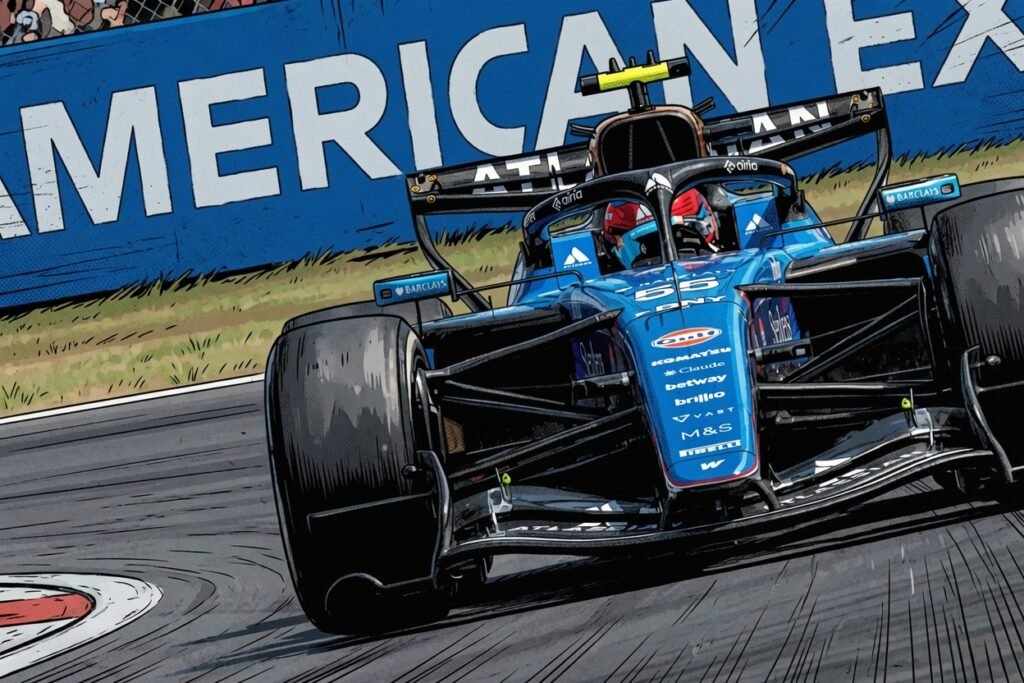
Silverstone crystallised it. A new front wing — originally slated for Spa, and accelerated to arrive early — had shown “a lot of laptime in the windtunnel and in the simulator.” On track, it delivered almost nothing. When the tools that design a car promise gains the circuit doesn’t confirm, the problem is no longer any individual part: it’s the machinery of development itself.
Williams’ 2026, in numbers
- The FW48 began the season up to 28kg over the weight limit — an immediate laptime penalty.
- 11 points all season; none since Sainz’s eighth place in Monaco, four races ago.
- Audi, its nearest rival, closed to within five points after Bortoleto’s Silverstone eighth.
- Sainz’s comparison: roughly 1.6-1.8s off the pace at Suzuka with a heavy car; two seconds off at Silverstone with a much lighter one.
A problem born in the car’s build
The deeper diagnosis, as The Race details, traces back to how the FW48 came into existence. James Vowles has spent three and a half years trying to transform Williams from a team running outdated, inefficient processes into a frontrunning operation — and the 2026 build brutally exposed how incomplete that metamorphosis remains. Vowles has admitted he couldn’t trust the data during the design process, with key problems flagged far too late by the team’s overloaded internal systems. His attempt to reframe the pain is characteristically forward-looking.
Never let a good crisis go to waste. The amount of changes we have made have put us into a very good situation for the future, and I don’t think we would have made them if we’d partially succeeded this winter. So as painful as it’s been, I believe we have to go through it as well. — James Vowles, Williams Team Principal
The trouble with that framing is its timeline. The structural changes should benefit the 2027 and 2028 cars; they do little for a 2026 campaign Vowles himself has compared to “flying the plane and rebuilding it at the same time.” His roadmap promises smaller updates at Spa and Budapest, a weight-focused package at Zandvoort, and then what he openly calls a “B-spec” car — new chassis included — around the Azerbaijan Grand Prix in September.
Why Sainz doesn’t trust the Baku promise
Sainz’s response to that roadmap is where his worry becomes pointed. He isn’t questioning the team’s effort — by his own account he was in the simulator early on Thursday morning at Silverstone before media day, and insists he’ll return to the factory “smiling” — but he is applying an uncomfortable piece of logic to the B-spec hype: “If everything we’ve brought so far isn’t a step forward, why should it be from Baku?” Until Williams understands why its windtunnel numbers aren’t surviving contact with the track, he argues, there’s no reason to believe the biggest package of the year will behave any differently from the smallest.
The contract clock ticking underneath it all
Hovering over the technical story is a personal one. Sainz’s deal runs through the end of 2026, paddock speculation persists about performance-related clauses, and the driver himself has been open about his plan: work flat-out for Williams until the summer break, then sit down and “look at the options.” Those options are constrained — no top-team seat is available barring a Verstappen earthquake — but the midfield teams Sainz rejected to join Williams in the first place, Alpine and Audi among them, are now the very cars driving past him on Sundays. That’s an irony with recruitment implications.
- Sainz chose Williams over Alpine and Audi offers in 2024, betting on the Vowles project’s trajectory.
- His entire 2026 points haul consists of three ninth places (China, Miami, Canada) and eighth in Monaco.
- Teammate Alex Albon retired at Silverstone; Williams was the only midfield team to leave the weekend pointless alongside Haas and Aston Martin.
- The Baku B-spec is now the checkpoint by which Sainz — and the paddock — will judge whether Williams’ problem is a blip or something endemic.
None of this means the Sainz-Williams project is finished — his commitment, visibly, hasn’t wavered, and 2026’s brutal development race has humbled far bigger operations. But the nature of his worry has changed. It’s no longer about a slow car; it’s about whether the team can trust its own tools to make the car faster. Until Baku answers that question, every windtunnel gain Williams announces will carry an invisible asterisk — and its star signing will keep doing the maths on a bet that hasn’t yet paid off.
Discover more from f1liveupdates.com
Subscribe to get the latest posts sent to your email.