
Zero Percent at Eau Rouge: Russell’s Unheard Fury and the Glitch That Broke His Race
Millions watched George Russell gesture furiously from the Les Combes gravel — and heard nothing. Hours later, a German channel revealed what the world feed had withheld: an expletive-laden message about a battery that never charged, and a Mercedes software error that ended his race before it began.
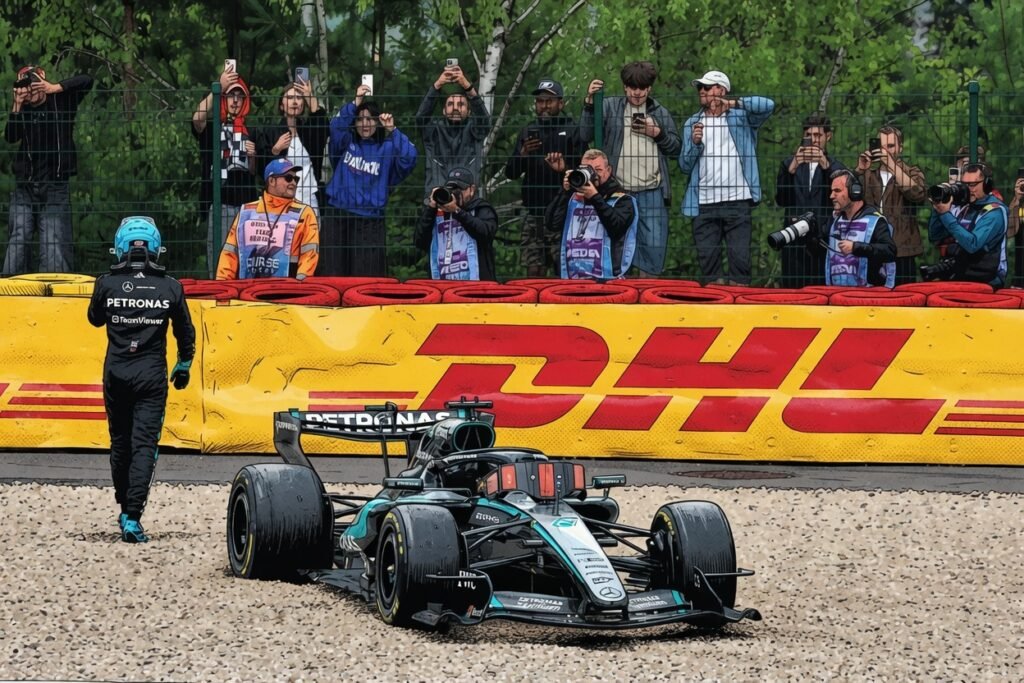
The images said plenty: a Mercedes beached in the gravel, its driver waving his hands in the cockpit, clearly mid-sentence. The sound said nothing at all. As the Safety Car circulated at Spa on Sunday, Formula 1’s international broadcast — and even F1 TV’s own onboard channels — registered no radio message from George Russell. It took the German-language feed, carried on F1’s own platform, to replay what Russell had actually said moments before the restart. And it was combustible.
The Message F1 Didn’t Air
“I’m out. What the f*** happened with the SoC [State of Charge] down the straight? I had no f***ing battery down the straight! Guys, unacceptable. Un-f***ing-acceptable this whole weekend.”
— George Russell, Mercedes, over team radio after his lap-one retirement
Strip away the profanity and what remains is not a driver raging about a collision — Russell would later call his tangle with Lewis Hamilton “a racing incident” — but one raging about physics. His anger was aimed at an energy system that had betrayed him up the Kemmel Straight, leaving him defenceless in the moments before contact. And the data, it turns out, backs every word.
Zero Percent: What Actually Happened
Russell’s account after the race was forensic. The battery simply failed to recharge through Turn 1, he explained — he exited La Source already 35% down, triggering a cascade: a boost problem, a turbo that “didn’t sort itself out”, and, by the top of Eau Rouge, an empty tank.
“I got to the top of Eau Rouge with 0% on the battery. Quite frankly, it was dangerous. I got swamped by three cars. Shouldn’t have been in that position in the first place, and that’s why I’m most angry.”
— George Russell, speaking after the race
Telemetry from the opening lap illustrates the ambush in numbers. Russell trailed team-mate Kimi Antonelli by 10 km/h (6 mph) before Eau Rouge, yet still carried 310 km/h (193 mph) through the compression — fastest of the frontrunners. Exiting Raidillon, though, the cliff edge arrived: flat on the throttle, boost button deployed at his engineer’s request, and his speed simply stopped, capped at 308 km/h (191 mph) for several seconds while the pack inhaled him. Antonelli, afflicted by the same malaise in milder form, survived it in stages — capped momentarily at 313 km/h (195 mph), then 318 km/h (198 mph) — enough to draft back past a power-sapped Verstappen and, ultimately, to win the race.
Toto Wolff’s post-race admission was as remarkable as the failure itself: every Mercedes-powered car suffered the energy shortage out of La Source. The cause, it is understood, was a software error that prevented full deployment at maximum speed — unrelated to the recharge-limit problems that hobbled Mercedes early in the season, and undetected on the grid, where Russell had been assured his state of charge looked perfect. The team principal shouldered the blame in full: “That hit him badly and it 100% goes on us.”
Why You Never Heard It
The absence of the message from the world feed was no glitch — it was policy. Every radio transmission in Formula 1 passes through a team of eight editors and producers at the championship’s Biggin Hill broadcast centre before it reaches your screen, sorted into three tiers: fully transcribed with audio, audio-only, or text-only. That human filter is why radio often trails the pictures by up to 15 seconds — and why some messages never arrive at all.
The framework dates back to Ross Brawn’s tenure as F1’s managing director of motorsport, built on a simple principle: protect drivers from themselves. Borderline messages get a bleep. Messages as raw as Russell’s get buried. F1’s director of broadcast and media, Dean Locke, explained the philosophy at Biggin Hill last year.
“There is a responsibility. Is there something they may regret? We have to sort of protect them a little bit from that. So we have a function that we can deal with that: mute it, bleep it occasionally.”
— Dean Locke, F1 director of broadcast and media
The Conspiracy Corner
Inevitably, the vacuum filled with theories — that F1 had deliberately suppressed criticism of the 2026 deployment rules, or even that the leaked audio was AI-generated. Both collapse under scrutiny: the message is authentic, and its emergence via the German feed has a mundane explanation. Some broadcasters can access unfiltered radio channels rather than waiting for Biggin Hill’s selections, and with 22 drivers talking for two hours, a beached title contender’s outburst was the most obvious listen of the afternoon.
Russell’s Lap One, in Numbers
- 0% — battery charge at the top of Eau Rouge
- 35% — his energy deficit exiting the first corner
- 308 km/h (191 mph) — the speed his car refused to exceed, boost button or not
- 10 km/h (6 mph) — his deficit to Antonelli before Eau Rouge
- 8 — editors filtering every radio message at Biggin Hill
- ~15s — the built-in delay between pictures and radio
- 50 points — his new championship deficit to Antonelli
What It Leaves Behind
The fallout is double-edged. In the standings, Russell now trails his 19-year-old team-mate by 50 points, a gap that transforms Hungary from opportunity into last chance saloon before the summer break. In the court of public opinion, though, the muted microphone has done something curious: a message F1 judged too toxic to air has now been heard by millions more than any broadcast could have delivered.
Russell, for his part, described himself as “numb to the disappointment” — the weariness of a driver who began the year as title favourite and keeps watching software decide his Sundays. Mercedes insists it has the most powerful power unit on the grid. At Spa, for one decisive kilometre, it had a car with no power at all — and a driver’s honesty that no mute button could contain.
Sources
- The Race — Russell’s radio message, the telemetry and the Biggin Hill filter explained
- PlanetF1 — Untelevised Russell radio reveals sweary message to Mercedes
- GPblog — Russell’s furious Mercedes radio emerges; Wolff reveals power unit issues
- Crash.net — Russell drops f-bomb in unheard team radio at Belgian GP
- ESPN — Russell lashes out at Mercedes in unheard team radio
Discover more from f1liveupdates.com
Subscribe to get the latest posts sent to your email.