A Win and a Warning: Mercedes Leaves Spa Chasing Answers Over Its Engine
Kimi Antonelli’s Belgian Grand Prix victory extended his championship lead to 45 points — yet behind the celebrations, Mercedes departed the Ardennes with a power unit question it cannot yet answer, one that touches not just the works cars but every team it supplies.
There was champagne on the podium and unease in the engineering office. Mercedes won the Belgian Grand Prix on Sunday — a sixth victory of the season for Kimi Antonelli, a 45-point championship cushion, a title fight tilting its way. And yet the clearest takeaway from Spa-Francorchamps was a confession from Toto Wolff that cut through the celebrations: the fastest team of 2026 does not fully understand what its own power unit is doing.
The Admission That Stopped the Paddock
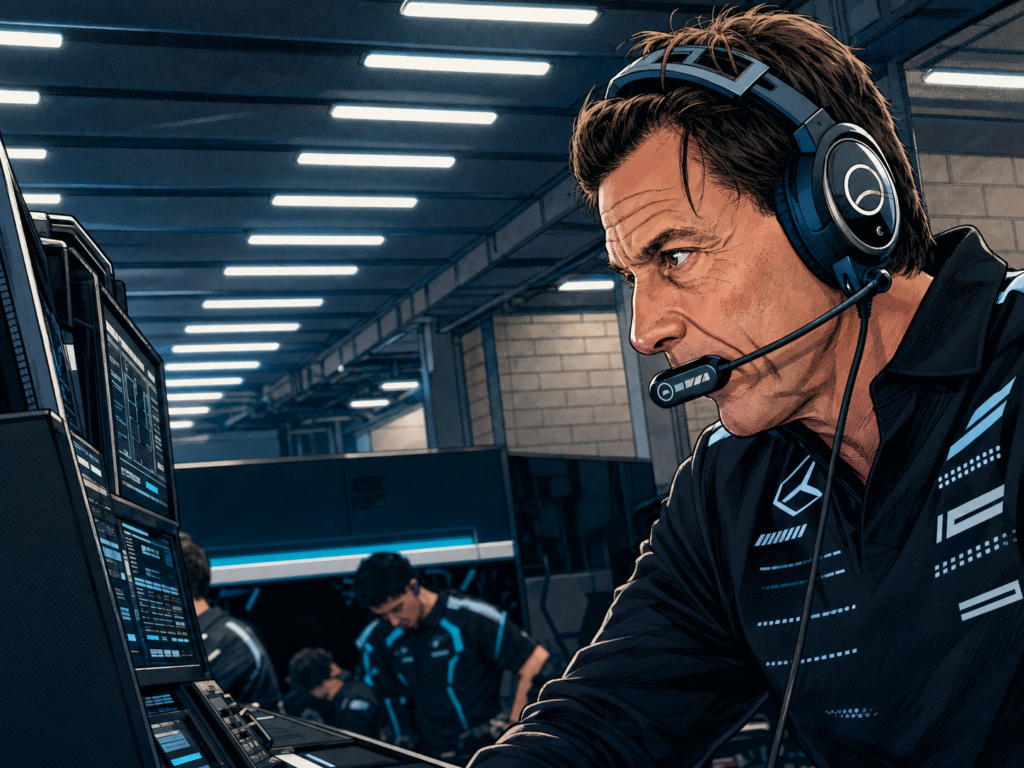
It came after qualifying, with George Russell half a second adrift of his pole-sitting team-mate and unable to explain why. Wolff, speaking to F1 TV, went further than team principals usually go — pointing the finger of suspicion at the very heart of the car.
“George is obviously suffering from a lack of straight-line speed we are unable to explain – a couple of tenths. We’ve literally left no stone unturned. Is it the power unit? Kimi has a brand-new power unit and this makes the difference? We will see on the next tracks because they will be less energy starved.”
— Toto Wolff, Mercedes team principal
The detail that elevates this from setup gripe to genuine concern: Russell’s deficit lived almost entirely on the straights. Friday’s data showed him losing the bulk of his time in the zones where the Mercedes deployment map demands a lift before the timing line — a harvesting shortfall, not a handling one. Twenty-four hours later, racing with “no speed down the straight” in his own words, he was swallowed by two Ferraris and made the lunge that ended his race in the Les Combes gravel after contact with Lewis Hamilton. The thread from telemetry to retirement is impossible to ignore.
Not One Car — a Whole Stable
What makes this a story beyond Brackley is that Mercedes’ engine lives in eight cars. McLaren, Williams and Alpine all run the same hardware — and all three only recently received the revised, reliability-focused specification that debuted on the works cars in Austria, reached Alpine and Williams at Silverstone, and finally landed at McLaren for Spa. The rollout itself told a story: a manufacturer playing catch-up on its own creation.
The 2026 ledger of pain spans the entire Mercedes family:
- Mercedes: Antonelli’s retirements in Barcelona and at Silverstone — the latter prompting Wolff to declare in June that his team “can’t compete for a championship with power unit unreliability issues”. A fourth power unit went into the Italian’s car for Spa, with the Silverstone engine shipped back for inspection; he is now one failure from a grid penalty.
- McLaren: both cars failing to start in China after separate battery failures, a further battery issue for Norris in Monaco, and a 10-place grid penalty at Spa for exceeding power electronics allocation.
- Williams: Carlos Sainz’s earlier engine problem forced the change that unlocked the new specification — and at Spa the team finished an anonymous 15th and 16th.
- Alpine: running the new spec but fighting for scraps, a single point from Sunday its best return.
Mercedes’ Power Unit: The State of Play
- 8 cars — run Mercedes power in 2026: works, McLaren, Williams, Alpine
- 4th PU — fitted to Antonelli’s car at Spa; one more means a penalty
- “A couple of tenths” — Russell’s unexplained straight-line deficit
- August 1, 2026 — FIA’s tougher compression-ratio test takes effect
- 130°C — the operating temperature at which engines must now comply
- 45 points — the championship lead riding on finding answers
The Shadow of the Compression Ratio
Looming over all of it is the technical controversy that has stalked Mercedes since February. Rivals allege the German manufacturer found a way for its engine to run a higher compression ratio on track than the 16:1 limit permits — while still passing the FIA’s checks, which were conducted only at ambient temperature. The governing body’s response is now enshrined in the rulebook: from August 1, compliance must be demonstrated at a representative operating temperature of 130°C.
The change carries no retroactive punishment — Mercedes and its customers were given time to adapt rather than sanctions to absorb — but it nonetheless obliges the marque to modify the very power unit that has underpinned its season, just as the championship enters its decisive third. Any performance surrendered in the process will be felt not by one team, but by four.
Budapest as a Laboratory
Wolff’s chosen framing — “we will see on the next tracks because they will be less energy starved” — turns the Hungarian Grand Prix into an unscheduled experiment. The Hungaroring’s twisty 4.381-kilometre (2.722-mile) layout asks far less of a power unit than Spa’s endless full-throttle climbs. If Russell’s straight-line ailment vanishes there, the diagnosis points to energy management — software, harvestable and fixable. If it follows him to Budapest, Mercedes has a hardware problem with a 45-point lead to protect and a mid-season rule change already queued in the pit lane.
Antonelli’s serene Sunday suggested the ceiling remains high. But championships are rarely lost on the days everything works. They are lost on the days the garage cannot explain what it is looking at — and Mercedes has now had several of those in a row.
Sources
- Formula1.com — ‘Not his fault’: Wolff on Russell’s qualifying deficit to Antonelli
- Yahoo Sports / GPblog — Mercedes changes Antonelli’s power unit for Spa, escapes penalty
- The Race — McLaren gets latest Mercedes F1 engine two races after works team
- Speedcafe — McLaren to debut Mercedes power unit upgrade at Spa
- Sky Sports — Wolff: Mercedes can’t compete for a championship with power unit unreliability issues
- ESPN — McLaren critical of lack of Mercedes F1 engine information
- WION — Explained: Mercedes and the compression ratio issue
Discover more from f1liveupdates.com
Subscribe to get the latest posts sent to your email.