
Formula 1 · Technical Analysis
McLaren’s 2026 F1 Development Deficit Explained: Why Mercedes Has the Early Edge
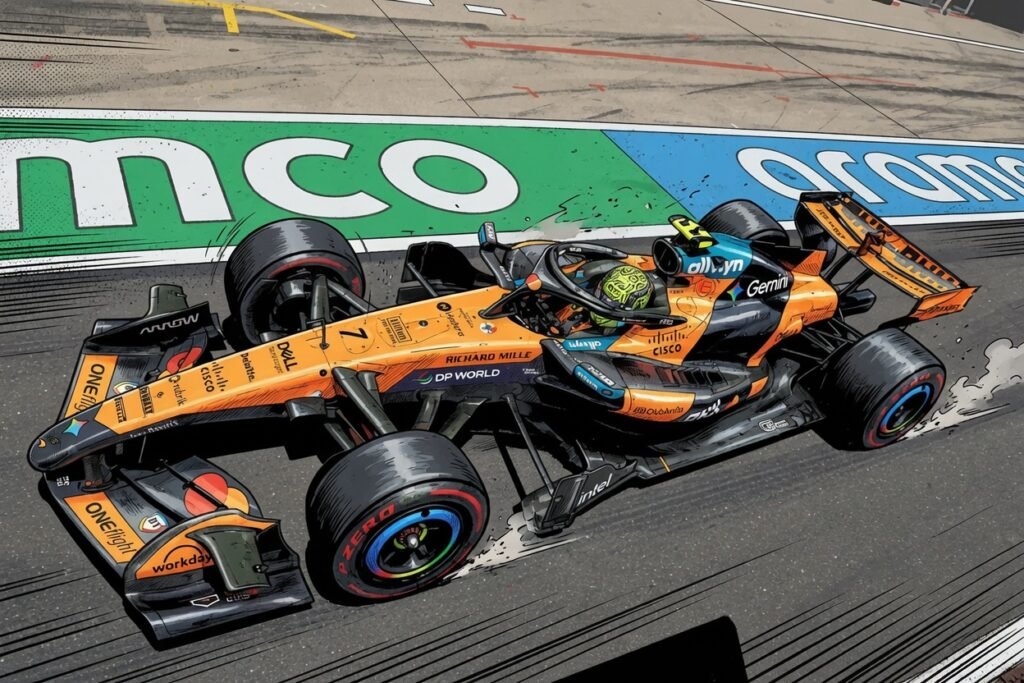
McLaren did not arrive in 2026 without ambition. It arrived with a different calculation—and the early cost of that calculation is a development gap measured not in tenths alone, but in months.
There is a crucial distinction behind McLaren’s difficult opening to Formula 1’s new era. The team is not saying that the MCL40 was built three months late. It is saying that, in aerodynamic development terms, it is now roughly two to three months behind Mercedes’ curve.
That is an uncomfortable admission for a team that entered 2026 as reigning World Champions. Yet it also explains why the papaya cars have often looked capable of flashes rather than sustained pressure: McLaren is trying to recover performance while Mercedes continues to add it.
In Formula 1, a three-month deficit is not a calendar problem. It is a pipeline problem. It means the rival’s wind-tunnel concepts, CFD findings, manufactured parts and track-validated upgrades are already further down the road. Closing that distance requires more than one successful package.
“We need to out-develop competitors.” Andrea Stella, McLaren Team Principal
A regulation reset that changed the order
The 2026 regulations have erased much of the continuity that normally rewards a championship-winning team. Formula 1 has introduced a new chassis philosophy, new active-aerodynamic operating modes, revised tyres and a radically different power-unit environment. The cars are narrower and lighter, while the aerodynamic platform has been reshaped around flatter floors and new wing concepts.
McLaren’s strength in the previous rules cycle did not automatically transfer. The MCL40 is a fresh technical project, not a polished evolution of its title-winning predecessor. The margin for carrying over setup knowledge, aero correlation and operational habits has therefore been far smaller.
The key context
McLaren chose not to lock itself into a large upgrade programme before it had enough real-world data from the new car. That was a deliberate attempt to establish a healthy development platform—but it left the team with less early momentum once Mercedes’ baseline proved so competitive.
The late-2025 championship fight had a price
McLaren’s 2026 compromises did not begin in winter testing. They began during the final months of 2025. Fighting for titles until the last race demanded engineering focus, manufacturing capacity and management attention at precisely the point when the 2026 programme needed to accelerate.
Every team faced the same strategic tension, but not every team carried the same workload. While McLaren had to keep extracting performance from its championship contender, Mercedes was able to arrive at the new rules set with a car that has established the early benchmark.
Andrea Stella has also pointed to McLaren’s design approach. The team wanted its launch specification to be a sound base for development rather than an overly committed first answer. That can be a sensible long-term choice under such sweeping regulations. The immediate consequence, however, has been that Mercedes and Ferrari appeared better prepared at the first round.
Where the MCL40 is losing time
The deficit is not hidden in one spectacular weakness. McLaren’s own assessment has identified a blend of cornering performance, aerodynamic efficiency and power-unit exploitation. At the Red Bull Ring, Stella placed the team’s gap to Mercedes at around three to four tenths, with most of that loss occurring through the corners.
That matters because it points first to downforce. Mercedes’ car is generating more load, allowing it to carry greater speed and make stronger use of the tyre through the lap. McLaren has also been examining drag and straight-line efficiency, areas that can compound the loss once the car reaches high-speed circuits.
- Cornering load: McLaren has identified a deficit in downforce generation against Mercedes.
- Aero efficiency: Drag and straight-mode performance are part of the investigation.
- Power-unit exploitation: McLaren has needed more time to unlock the full potential of its Mercedes-supplied package.
- Reliability: Early issues limited results and slowed the team’s learning process.
The customer-team complication
McLaren and Mercedes share the same power-unit supplier, but equal hardware does not automatically deliver equal performance. A works team has the advantage of designing the entire vehicle and power unit together from the first concept sketches. Packaging, cooling, energy deployment and operational understanding can all be optimised as one integrated project.
McLaren has made clear that it is working constructively with Mercedes High Performance Powertrains, and there is no evidence that the customer engine itself is a lesser specification. The challenge is integration: extracting every part of the package at a time when the new electrical systems and aerodynamic modes have created a steeper learning curve for everyone.
One upgrade will not erase a gap created across several development cycles. McLaren’s 2026 recovery challenge
Why the recovery will be measured in upgrades, not promises
Lando Norris has been realistic about the scale of the task. McLaren does not need one magic component; it needs a sequence of effective parts that work together on track. That is the difficult part of a catch-up campaign. The factory must identify the right direction, produce the upgrade rapidly, and ensure that it correlates once it reaches the circuit.
McLaren’s recent history offers reason for confidence. The team has previously transformed a significant early deficit through a powerful development rate. But 2026 is a different kind of test: the field is learning a new regulatory language at the same time, and Mercedes is not standing still while McLaren translates it.
What to watch next
The decisive question is not whether McLaren can bring upgrades. Every front-running team can. The real measure will be whether the MCL40’s incoming aerodynamic solutions deliver enough cornering load and efficiency to reduce the gap faster than Mercedes can extend its own advantage.
The verdict: a gap in momentum, not a lost season
McLaren’s three-month figure should be read as a frank measure of development momentum, not a declaration that the season is beyond rescue. The team has a capable technical group, a proven capacity to improve and a clear diagnosis of the areas that require attention.
But the early 2026 picture is sobering. Mercedes has combined a stronger initial aerodynamic platform with a more mature understanding of its complete package. McLaren is now fighting the most difficult contest in Formula 1: not simply chasing a quicker car, but trying to become the faster developer.
Sources
Discover more from f1liveupdates.com
Subscribe to get the latest posts sent to your email.